

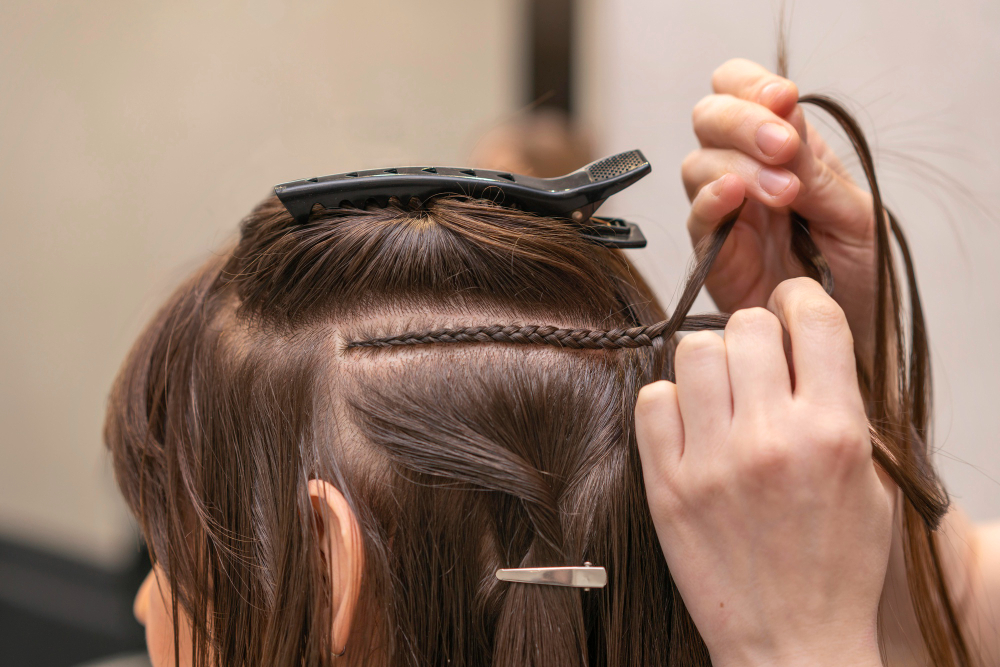

You sit down in the chair, the stylist parts your hair, and the braid begins. What happens in the first inch decides how the style will look and feel for weeks. That first inch is the whole story behind knotless braids in Colorado Springs and everywhere else, and it explains why two styles that look alike can feel so unlike each other on the scalp.
This guide explains the technique from the ground up. It covers how a traditional box braid is built, how a knotless braid is built, and where the two split apart. By the end, you will know the terms, the steps, and the trade-offs well enough to choose with confidence.
The Short Answer: Where the Braid Begins
A knotless braid starts with your own hair alone. The stylist braids a small amount of natural hair for a few crossings, then adds thin strands of extension hair a little at a time as the braid moves down. Nothing is tied or knotted at the root.
A traditional box braid starts differently. The stylist attaches a bundle of extension hair to a section of your hair at the base, usually with a knot or a firm wrap, and then braids all of it together from the first crossing. The braid carries the full extra hair from the very top.
That one change in the starting point is the whole difference in method. Everything else people notice, such as weight, flatness at the root, and comfort, grows out of it.
How a Traditional Box Braid Is Built
Box braids get their name from the shape of the parts. The stylist divides the hair into squares, or boxes, across the scalp. Each box becomes one braid. The parts can be larger or smaller depending on the size of braid you want.
Here is the usual order of work for a traditional box braid.
- The stylist sections the hair and clips most of it out of the way.
- One square section is combed smooth and held at the root.
- A piece of extension hair is joined to that section at the base.
- The natural hair and the extension hair are braided together from the first crossing down to the ends.
- The ends are sealed, often with hot water or a flame, depending on the type of hair used.
Because the extension hair is attached at the base, the root of each braid holds more material than the rest of the strand. That small bulge is the visible knot many people picture when they hear the words box braids.
The method is old and well tested. It produces a neat, firm, long-wearing braid. It also puts the full weight of the extension hair on the section of natural hair right at the scalp from the start.
How a Knotless Braid Is Built
Knotless braiding uses a method often called feed-in. Feed-in means the extension hair is added to the braid in stages instead of all at once. The result is a braid that begins slim and thickens as it travels down.
The Steps in Order
- The stylist sections the hair and parts a single base, just as with box braids.
- The natural hair in that part is braided for a few crossings with no extension hair at all.
- A thin strand of extension hair is laid into the braid and worked in.
- More thin strands are added with each few crossings until the braid reaches its full thickness.
- The braid continues to the ends and is sealed.
What Feed-In Means in Practice
The stylist controls how fast the braid thickens. A slow feed-in gives a long, gentle taper at the root. A faster feed-in gets to full thickness sooner. Each choice changes how the braid sits against the scalp.
The same idea shows up in other styles. Feed-in cornrows, for example, add hair to a raised row in the same gradual way. Knotless braiding applies that principle to individual braids.
Where the Two Techniques Differ
Side by side, the two methods compare on five points.
- Starting point: box braids begin with extension hair attached at the base, while knotless braids begin with natural hair only.
- Root shape: box braids have a small bulge where the extension hair is joined, while knotless braids lie flatter at the scalp.
- Weight at the root: box braids carry the full extra hair from the first crossing, while knotless braids add weight gradually.
- Movement: knotless braids tend to swing and part more naturally near the scalp, because the root is slim.
- Time in the chair: knotless braiding is more detailed work, so it often takes longer than a box braid of the same size.
None of these points makes one method right for everyone. They describe how each method is made. The sections below explain how those differences show up when the style is on your head.
What the Technique Means for Look and Comfort
The flat root is the first thing most people see. With no bulge at the base, the part lines look cleaner, and the braid appears to grow straight out of the scalp. Many people who search for knotless braids in Colorado Springs are looking for exactly that natural, close-to-the-scalp finish.
Comfort is the second difference. A box braid starts heavy, so the natural hair at the root carries more load. A knotless braid starts light and adds load as it moves away from the scalp. That slimmer start is why the method is often described as a lower-tension option.
Tension still depends on the person doing the work. Two stylists can both braid without a knot and apply very different pull. The size of the part, the thickness of the braid, the amount of extension hair, and the grip of the stylist all matter. A knotless braid done tightly can still feel sore.
Weight matters too. Long, thick braids are heavier than short, slim ones in any method. A smaller braid with a slow feed-in feels lighter than a large braid with a fast one. Choosing the length and size is part of choosing the comfort level.
Soreness in the first day or two after a braiding session is common with any braided style. Pain that is sharp, or that lasts, is a sign to speak up. A stylist can adjust a braid that is pulling, and the sooner the issue is raised, the easier it is to fix.
Which Hair and Styles Suit Knotless Work
The method works with a range of hair textures and lengths, but it needs enough natural hair to braid a few clean crossings before the extension hair joins. Very short hair can make the first crossings hard to hold. A stylist can tell you quickly whether your length is enough.
Knotless braiding also comes in more than one look. The standard version gives smooth, even braids. A boho version leaves loose, curly strands of hair hanging free along the braid for a softer, more textured effect. Both start the same way at the root. The difference is in the finishing.
Size changes the experience as well. Smaller braids take longer and look finer. Larger braids go faster and show more of the part lines. Medium sizes sit between the two. Many people pick the size by thinking about how long they want to sit and how much scalp they want to show.
Local salons describe their own methods in their own words. Betty African Hair Braiding, a salon on Galley Road in Colorado Springs, lists its braiding services, including knotless braids, boho knotless braids, regular box braids, twists, crochets, and feed-in cornrows. The salon page describes its knotless braids as lightweight, tension-free braids with a natural look, and it says appointments typically take a few hours.
A salon’s own description is a good place to start, but it is only a description. How a style feels depends on the hands that make it, so the questions you ask at the appointment matter as much as the menu.
Trade-Offs Worth Knowing Before You Choose
Every method has costs. Knowing them in advance keeps surprises out of the chair.
- Time: knotless braiding usually takes longer because each braid is built in stages. Plan for a long sitting and bring something to do.
- Cost: more labor often means a higher price than box braids of the same size, so ask for a quote before the work begins.
- Hair needs: very short or very fine hair may hold a knotless braid less easily at the start.
- Look: if you want a firm, bold, traditional look, a box braid delivers it with its familiar shape.
- Skill: the feed-in method is harder to do evenly, so the result depends heavily on the stylist.
Box braids remain a strong choice. They are sturdy, quicker to install than knotless braids, and still popular for good reason. The point is not that one method wins. The point is that each method trades something for something else.
A Hypothetical Comparison
Picture two clients with the same length of hair who both want medium braids. This example is imagined, not a real case. The first picks box braids because she wants the quickest sitting and a classic look. The second picks knotless because she has a tender scalp and wants a flatter root. Both choices are sound. They answer different needs.
Questions to Bring to Your Chair in Colorado Springs
Knowing the method lets you ask better questions. Before a stylist starts, a few plain questions clear up most of the uncertainty.
- Do you start each braid with natural hair only?
- How gradually do you add the extension hair?
- How large will each part be?
- How long will the sitting take?
- What should I say if a braid feels too tight?
The answers show whether the stylist builds the braid the way you expect. A stylist who explains the steps clearly usually works with care. One who cannot describe the method is a signal to ask more.
For anyone weighing knotless braids in Colorado Springs, the useful takeaway is simple. The method is defined by where the braid starts, and that starting point shapes the root, the weight, and the comfort of the whole style. Local salons such as Betty African Hair Braiding offer both knotless and box braiding, so the choice between methods can be made with a stylist who does each one.
Arrive with clean, fully dry, detangled hair unless the stylist says otherwise, and book ahead, since the salon recommends appointments in advance. Then the technique you now understand can do its work.