

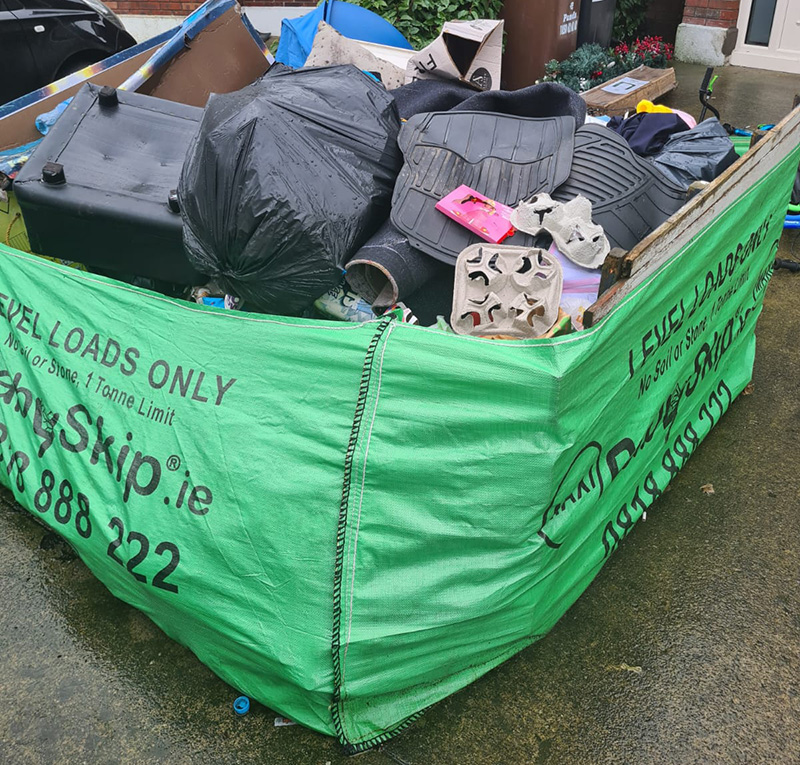

A full bag sitting by the gate should be the easy part of a clear-out. In practice, small errors made before the pickup day are what turn a simple job into a refused load, a second visit or a bill nobody expected. Most of them are easy to avoid once you know what to look for. This guide covers the common slips people make with skip bag collection Dublin, and what to do instead.
The advice here is practical and general. Where a detail depends on a particular collector, it says so, because rules and limits differ from one provider to the next. Always confirm specifics with whoever is collecting your bag.
How a Skip Bag Pickup Works in Dublin
A skip bag is a large, sturdy bag that you fill yourself and leave in a spot where a collection team can reach it. Once you book, the team arrives, loads the bag onto a vehicle and takes the waste away for sorting and disposal. There is no need to hire a full skip, and no need to find space on the road for one.
That simplicity is why bags suit small and mid-sized jobs. Think of a garden tidy, a bathroom refit, a garage clear-out or the leftovers from a house move. A bag sits on a driveway or in a front garden, fills up over a few days, and goes when you say it is ready.
The process usually follows the same four steps:
- Tell the collector your location, the type of waste and the size of the job.
- Fill the bag with accepted waste only.
- Book a pickup time that suits you.
- Have the bag ready and reachable when the team arrives.
Every mistake below comes from skipping or rushing one of those steps.
Mistake 1: Guessing the Bag Size Instead of Measuring the Job
The most common error is choosing a bag by feel. People look at a pile and say it will probably fit. Then the bag arrives, the pile is twice the size, and the second bag has to be ordered anyway.
Bag size is one of the main factors that shape the final cost, along with the type and weight of the rubbish, access, urgency and the number of bags. Getting the size wrong pushes more than one of those factors the wrong way.
How to correct it
- Stack or bag up the waste before you book, so you can judge the volume honestly.
- Count loose items as well as boxes. Furniture, offcuts and tools take up more room than they appear to.
- Describe the job to the collector in plain terms and let them advise on the right option.
- If you are close to the limit between two sizes, ask whether a second bag is simpler than a bigger one.
Mistake 2: Putting Restricted Waste in the Bag
This is the mistake most likely to stop a collection altogether. Skip bags take a wide range of ordinary waste, but some items are not accepted. Typical restricted categories include asbestos, paints and solvents, chemicals, gas bottles, medical waste, batteries, tyres, hazardous materials, certain electrical items and heavy industrial waste.
It is easy to slip one of these in by accident. A half-empty tin of paint at the back of the shed looks harmless. A car battery in the garage looks like just another heavy object. Yet a single restricted item can mean the load is left behind or has to be separated before it can go.
How to correct it
- Walk through the garage, shed and attic before you start, and set aside anything that holds liquid, gas or a charge.
- Ask the collector about any item you are unsure of. A short call beforehand saves a wasted visit.
- Look for hazardous waste outlets for the items the bag cannot take. Local authority facilities are the usual starting point.
- Keep an eye on older buildings. If you suspect asbestos in old sheeting, ceiling tiles or lagging, leave it alone and get specialist advice.
Mistake 3: Overfilling or Loading It Badly
A bag that bulges, with sharp offcuts poking through the top, is a problem for everyone. A bag that is overloaded with heavy material can split or become unsafe to lift. A bag with spikes of timber or glass can injure whoever has to handle it.
Weight matters as much as volume. Soil, rubble, tiles and wet garden waste weigh far more than they look. A bag that seems half full of broken tiles may already be too heavy to move.
How to correct it
- Fill to the top of the bag and no higher.
- Put heavy, flat items such as tiles and plasterboard at the bottom, and lighter material above them.
- Break down boxes, flat-pack furniture and long timber so they lie flat and do not stick out.
- Keep sharp edges inside the pile, wrapped or bundled, so they cannot tear the bag.
- Split very heavy materials such as soil across more than one bag.
Mistake 4: Leaving Out the Details About Access
A smooth skip bag collection Dublin booking depends on the route as much as the rubbish, yet people often describe the waste and forget the route. A team that arrives to find a narrow lane, a locked gate, a flight of stairs or a bag trapped behind a parked car loses time, and time is one of the things that affect price.
Access is also a safety question. A bag placed on a slope, under a low branch or next to a busy road is harder to load safely.
How to correct it
- Place the bag on flat, firm ground close to where a vehicle can stop.
- Tell the collector about stairs, gates, narrow entrances or parking limits when you book.
- Move cars and bins out of the way before the arrival window starts.
- If the bag has to be on a public road or footpath, check with the local authority first, because rules can apply there.
Where a Local Service Fits the Fix
Several of the problems above come down to one thing: a lack of local, practical advice at the point of booking. A provider that covers the city and knows what each type of job involves can catch an oversized pile or a risky item before it becomes a problem.
For example, Fast Junk & Rubbish Removal explains its skip bag collection service across Dublin, including the waste it accepts, the items it asks customers to check first and how bookings work. The page lists household rubbish, garden waste, wood, cardboard, plastic, broken furniture and non-hazardous renovation waste as typical contents, and it notes that same-day service may be available depending on location and schedule. Reading a provider’s accepted and restricted lists before you fill a bag is one of the simplest ways to avoid refusals.
Mistake 5: Choosing on Price Alone
A low headline figure can look attractive, but it tells you little by itself. Ask what the quote covers. Does it include the loading? Does it include disposal? Does it assume a particular weight or type of waste? Some quotes look cheap until extra items are added on the day.
There is also the question of who is carrying the waste. In Ireland, households have a duty to make sure their waste goes to someone authorised to handle it. That makes it sensible to ask any collector how the waste will be taken away and where it will be sorted and disposed of. A reputable provider will answer without fuss.
How to correct it
- Ask for a quote that spells out what is included.
- Describe the waste type, the number of bags and the access, so the figure reflects the real job.
- Ask how the waste is handled afterwards, and whether materials are recycled where possible.
- Keep a record of the booking and the quote in case a question comes up later.
Mistake 6: Booking Too Late or Too Early
Timing trips people up in two directions. Book too late and you may be left with a full bag and a deadline, such as a house sale, a landlord inspection or a rented skip returning. Book too early and an empty bag sits outside for days, which may annoy neighbours or invite someone else to fill it with their own rubbish.
Same-day and next-day slots can sometimes be arranged, but they depend on location and schedule. They are not guaranteed, so urgent jobs still benefit from some notice.
How to correct it
- Book once the bag is nearly full, not when you start.
- If you have a hard deadline, allow a buffer day.
- Keep the bag on your own property while it fills, and keep it covered if rain is likely, because wet waste is heavier.
- Tell the team if the waste has grown since you made the booking.
Mistake 7: Treating Garden Waste and Renovation Waste the Same
Garden waste is light and bulky. Renovation waste is often heavy and dense. They behave differently in a bag, and mixing them badly is how bags get overweight.
Grass, leaves, hedge trimmings and branches fill a bag fast but weigh little. Tiles, flooring offcuts and plasterboard fill it slowly but weigh a lot. Soil and old plant pots add weight too, and the amount accepted can be limited.
How to correct it
- Use separate bags for garden clippings and for building or renovation waste when the job is large.
- Cut branches down to a manageable length.
- Drain pots and shake off excess soil before they go in.
- Ask about limits on soil, plasterboard and other dense materials.
A Short Pre-Booking Checklist
Before you pick up the phone, run through this list. It catches almost every mistake covered above.
- I have estimated the volume and weight of what is going.
- I have removed anything restricted, such as paint, chemicals, batteries, tyres or gas bottles.
- I know where the bag will sit and that a vehicle can reach it.
- I have asked what the quote includes.
- I have chosen a pickup time that fits the deadline.
Is a Skip Bag Worth It Once the Mistakes Are Out of the Way?
For small and mid-sized jobs, usually yes. In many cases a bag is cheaper than a full skip, and it needs far less space. The saving only holds, though, if the bag is the right size, the contents are accepted and the team can reach it easily. Those three things are the ones people get wrong most often.
Done properly, skip bag collection Dublin is quick and low stress. You measure the job, keep restricted items out, load the bag with care, give clear access details and pick a sensible time. The team does the heavy lifting, and the waste goes for sorting and disposal.
The practical details above are general guidance, and each provider sets its own rules. Fast Junk & Rubbish Removal, for instance, asks customers to check restricted items with the team before booking, which is a good habit with any collector. A quick conversation before the bag is filled is far cheaper than a second visit.